
.jpg)
The UK’s provisional Official Development Assistance (ODA) statistics for 2025 reveal a significant shift in scale and priorities.
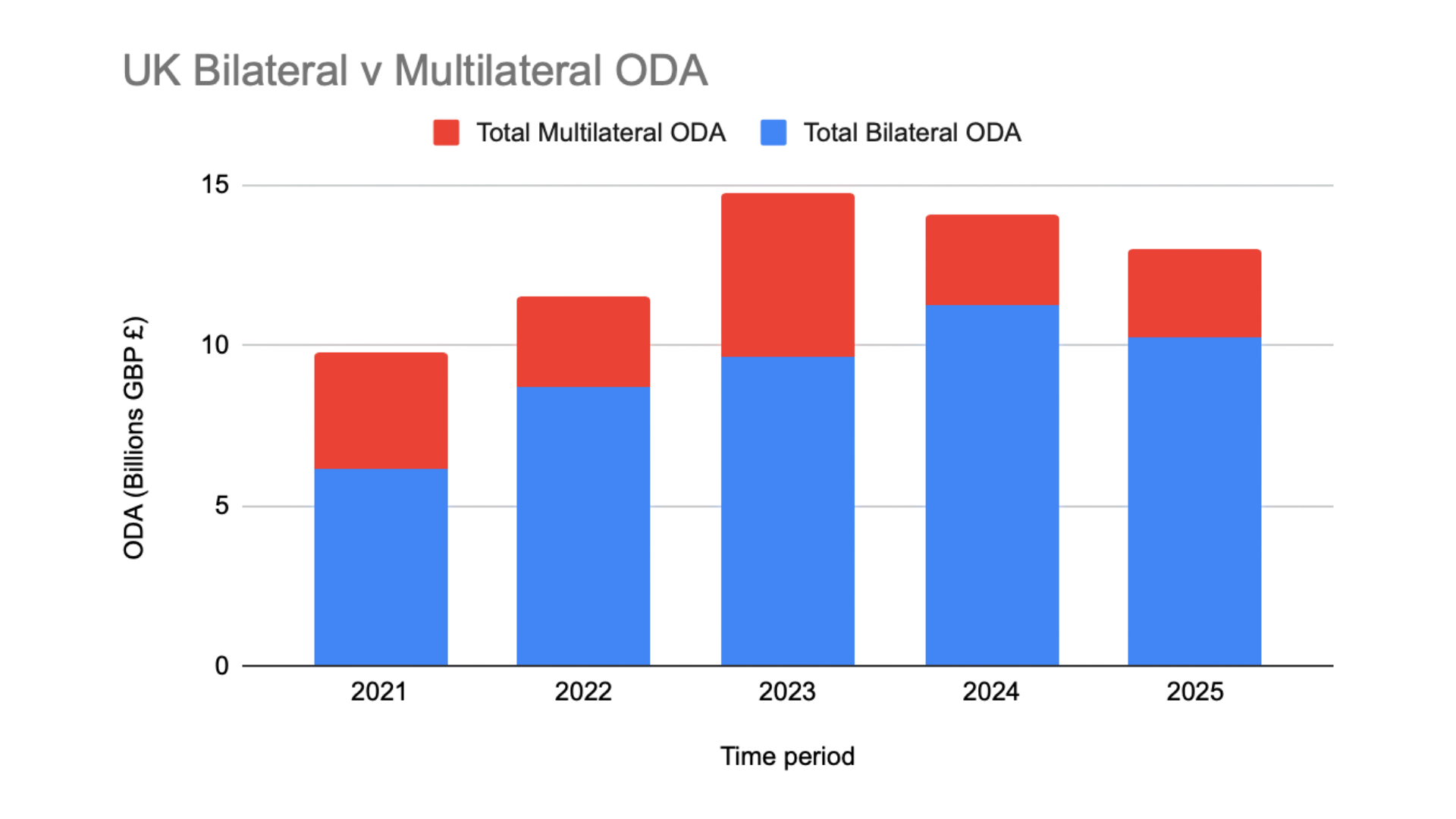
Total UK ODA reached £13.036 billion, representing a 7.4% decrease compared to 2024, with the ODA: GNI ratio standing at 0.43%. This reduction had already been anticipated following the government’s announcement that the UK would lower aid spending to 0.3% of GNI by 2027 in order to increase defence spending.
While the reduction itself is not unexpected, the data highlights several trends shaping the UK’s development approach.

Bilateral vs Multilateral Aid
In 2025, the UK delivered £10.2 billion (78.7%) of its ODA through bilateral channels, while £2.7 billion (21.3%) was delivered through core contributions to multilateral organisations. Compared to previous years, the share delivered through bilateral programmes has slightly decreased, while the multilateral share has increased, though it remains far below the 35% level recorded in 2023. This shift is occurring in a wider geopolitical context where approaches to development cooperation are diverging.
The United States has recently reduced its multilateral engagement, redirecting resources toward bilateral partnerships and withdrawing from dozens of international agencies and agreements, including the World Health Organization and the UN Human Rights Council. Meanwhile, European leaders are emphasising the continued importance of multilateral cooperation, arguing that collective action allows countries to pool resources and achieve greater global impact. At the One Health Summit organised by France, President Emmanuel Macron notably called for strengthening multilateralism in global health governance.
Regional allocation
Regionally, Africa continues to receive the largest share of UK bilateral ODA, reaching £1.685 billion in 2025, up from £1.601 billion in 2024.
Bilateral ODA also increased in most regions:
- ODA to Europe increased by £11 million.
- ODA to the Americas rose by £45 million,, reaching £150 million
In 2025, Asia was the only region where bilateral ODA declined.
In-donor refugee costs
Spending on in-donor refugee costs (IDRC) fell significantly in 2025, decreasing by 15.3% to £2.395 billion, representing 18.3% of total UK ODA. This follows growing criticism about the use of ODA for domestic asylum costs. In its 2025 review, the Independent Commission for Aid Impact warned that allocating aid to in-donor refugee costs delivers poor value for money and does not effectively support the UK’s international development priorities. More recently, the government announced the closure of 11 asylum hotels, as part of a broader commitment to end the use of hotels for asylum seekers by the end of the current parliament.
A global contraction in aid
The UK’s reduction in aid is occurring alongside a much wider contraction in global development financing. According to preliminary figures from the OECD Development Assistance Committee, total ODA from DAC donors fell by 23% in 2025 compared to 2024, the largest annual decline ever recorded. The majority of this decline was driven by five donors: the United States, Germany, the United Kingdom, Japan and France, which together accounted for 95.7% of the total drop.
The United States alone accounted for nearly three-quarters of the decline, with its ODA falling by 56.9%, marking the largest reduction in aid volume by any donor in a single year on record.

Research from ISGlobal and The Lancet Global Health suggests that cuts of this magnitude could result in more than 9.4 million preventable deaths by 2030, highlighting the potential human consequences of shrinking development budgets.
What’s next?
With the UK set to further reduce its aid budget to 0.3% of GNI by 2027, the coming years will likely raise questions about how limited resources are prioritised, the balance between bilateral and multilateral engagement, and the overall effectiveness of UK development spending. In a moment where global challenges, from health security to climate change, require coordinated responses, the debate over how countries engage with international development systems is likely to intensify.
Contributors: Soufyane Badreddine ; Mathilde Benguigui ; Reem Berrada
Related posts




Let's work together
Book a consultation by completing the form below.