
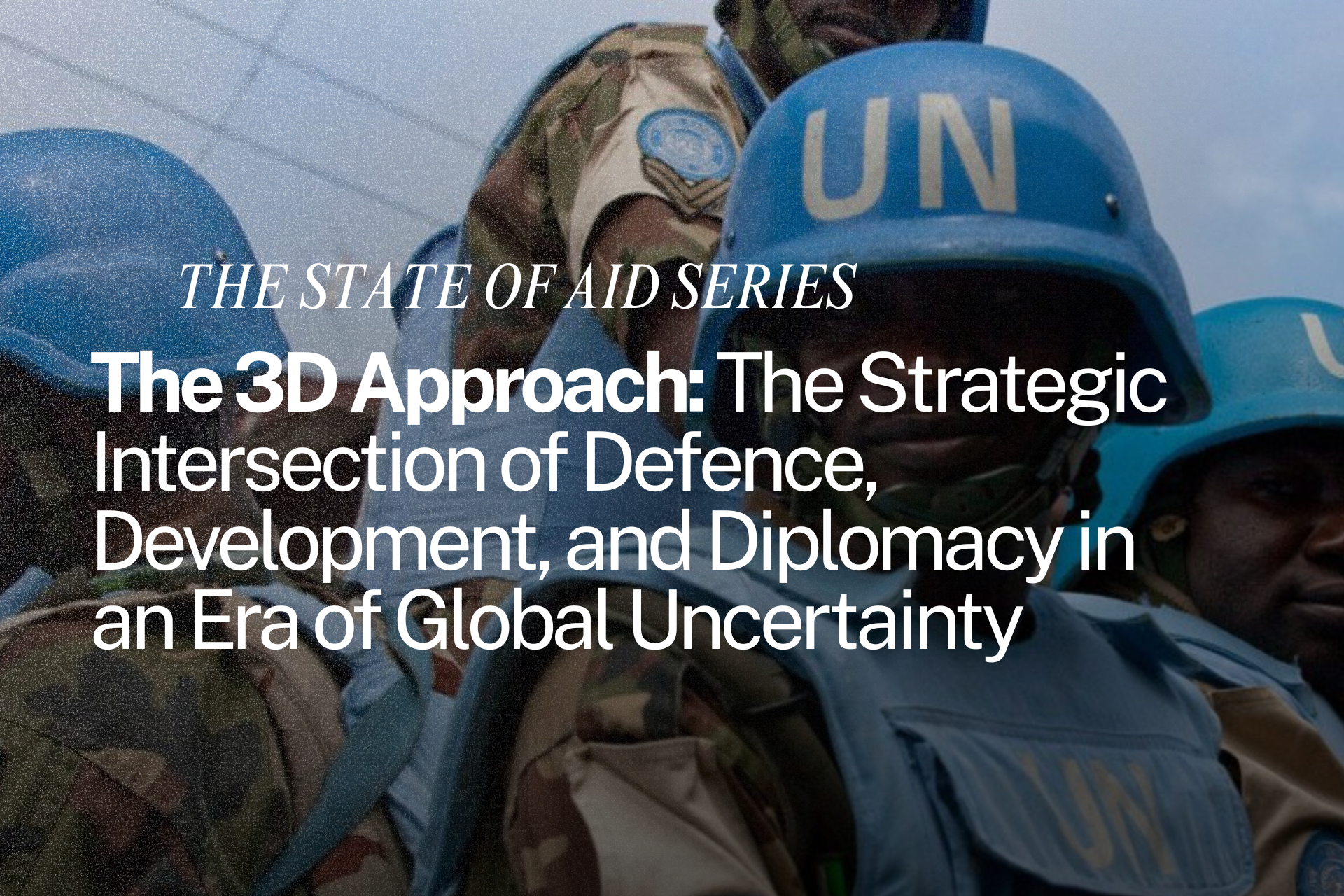
Defence, development and diplomacy should be understood as intersecting policy domains. Contemporary challenges, from the wars raging in the Middle East and Ukraine, to climate insecurity, cyber threats and global economic fragmentation demonstrate that security, sustainable peace, and stability are the results of the effective integration of defence capabilities, developmental investments and consistent diplomatic engagement.
This "3D approach" defence, development and diplomacy, has become increasingly relevant in shaping how states respond to complex international challenges. Recent developments in the United Kingdom, NATO and the broader international system illustrate why these three pillars must work together rather than in isolation. In recent years, the resurgence of interstate conflict has returned defence spending to the centre of international politics, with some countries seeking to close the wide gaps in defense spending exposed by the rise of these conflicts. NATO members have significantly increased military investment following Russia's invasion of Ukraine, with the alliance agreeing new capability targets and discussing defence expenditure equivalent to 5% of GDP, including investments in military capabilities and critical infrastructure. NATO Secretary General Mark Rutte has argued that the alliance requires substantial increases in air and missile defence capacity to respond to emerging threats.
Similarly, the UK's Strategic Defence Review (SDR) 2025 presents a vision of "warfighting readiness" and emphasises strengthening Britain's role within NATO while increasing defence expenditure to 2.5% of GDP by 2027. The review argues that Britain faces a more serious and less predictable security environment than at any point since the Cold War, requiring substantial investment in military capabilities, innovation and resilience. However, military power alone cannot address the root causes of insecurity. Many contemporary security challenges including, political instability, poverty, state fragility and resource competition, are fundamentally developmental issues. Countries experiencing chronic underdevelopment often become vulnerable to conflict, displacement and extremism, generating regional and global security consequences. As history shows across global south countries, military stabilisation efforts rarely produce lasting peace unless accompanied by institution-building and social investment. Development should therefore be seen as a preventative security strategy.
Development has traditionally been viewed through the lens of poverty reduction and economic growth. Yet current global events increasingly demonstrate its preventive, and in that sense, strategic significance.The shift in aid policy reflects broader changes in the global order, alongside an adoption of increasingly inward-looking strategic priorities.
Climate change provides a clear example. Extreme weather events, food insecurity and resource scarcity are contributing to migration pressures and political instability across multiple regions. These challenges have direct implications for national and international security, requiring coordinated responses that involve more than military forces. Likewise, infrastructure investment, technological innovation and economic resilience have become central components of contemporary security strategies. Indeed, NATO's emerging approach recognises this reality by linking defence spending to military capability as well as infrastructure, resilience and security-related investments. Similarly, the UK’s SDR highlights the relationship between defence investment and economic growth, presenting defence spending as a mechanism for strengthening domestic industry, innovation and technological capacity.
Another good example would be the recent Ebola outbreak in Uganda. This outbreak illustrates the growing overlap between health security and national security. While military forces can provide logistical support during health emergencies, long-term resilience depends on development investments in healthcare systems and diplomatic cooperation to coordinate surveillance, information sharing and international assistance.
Now, if defence provides protection and development addresses countries’ vulnerabilities, diplomacy serves as the mechanism through which states manage competition, build cooperation and prevent conflict.
Current geopolitical tensions illustrate diplomacy's continuing importance. While NATO members are strengthening military capabilities in response to Russian aggression, alliance leaders simultaneously emphasise diplomatic coordination among allies and partners. NATO's engagement with Ukraine, cooperation with the European Union and partnerships across the Indo-Pacific demonstrate that security challenges increasingly require multilateral diplomatic solutions. In the same way, concerns about China's growing military capabilities have generated renewed diplomatic activity throughout the Indo-Pacific region. At the Shangri-La Dialogue, discussions focused on alliance management and maintaining communication channels among major powers.
Diplomacy is also crucial for coordinating development efforts. International development finance, climate agreements, humanitarian responses and peacebuilding initiatives all depend upon diplomatic relationships and institutional cooperation. Without diplomacy, development programmes often struggle to achieve scale and sustainability.
While recent policy developments like those proposed and presented in the SDR suggest that governments increasingly recognise the interconnected nature of defence, development and diplomacy, some work is left to be done to see countries practice it.
This integrated approach is becoming increasingly necessary because contemporary threats are interconnected. Indeed, cyberattacks can target critical infrastructure; climate shocks can exacerbate conflict; economic coercion can undermine sovereignty; and technological competition can reshape global power balances. No single policy instrument can address these challenges independently. Accordingly, the twenty-first-century security environment demands a more holistic understanding of power and stability. Defence remains essential for deterrence and protection, particularly in an era marked by renewed geopolitical competition. Development addresses the structural vulnerabilities that often fuel instability and conflict. Diplomacy enables cooperation, conflict management and collective action across borders.
It is likely that the future of international security, development, and diplomacy will depend on recognising mutual dependence and the need for multilateralism. In turn, it seems reasonable to write that, in a world characterised by complex and interconnected challenges, the most effective strategy is the integration of the 3D approach.
Contributors: Soufyane Badreddine ; Reem Berrada
Related posts




Let's work together
Book a consultation by completing the form below.